
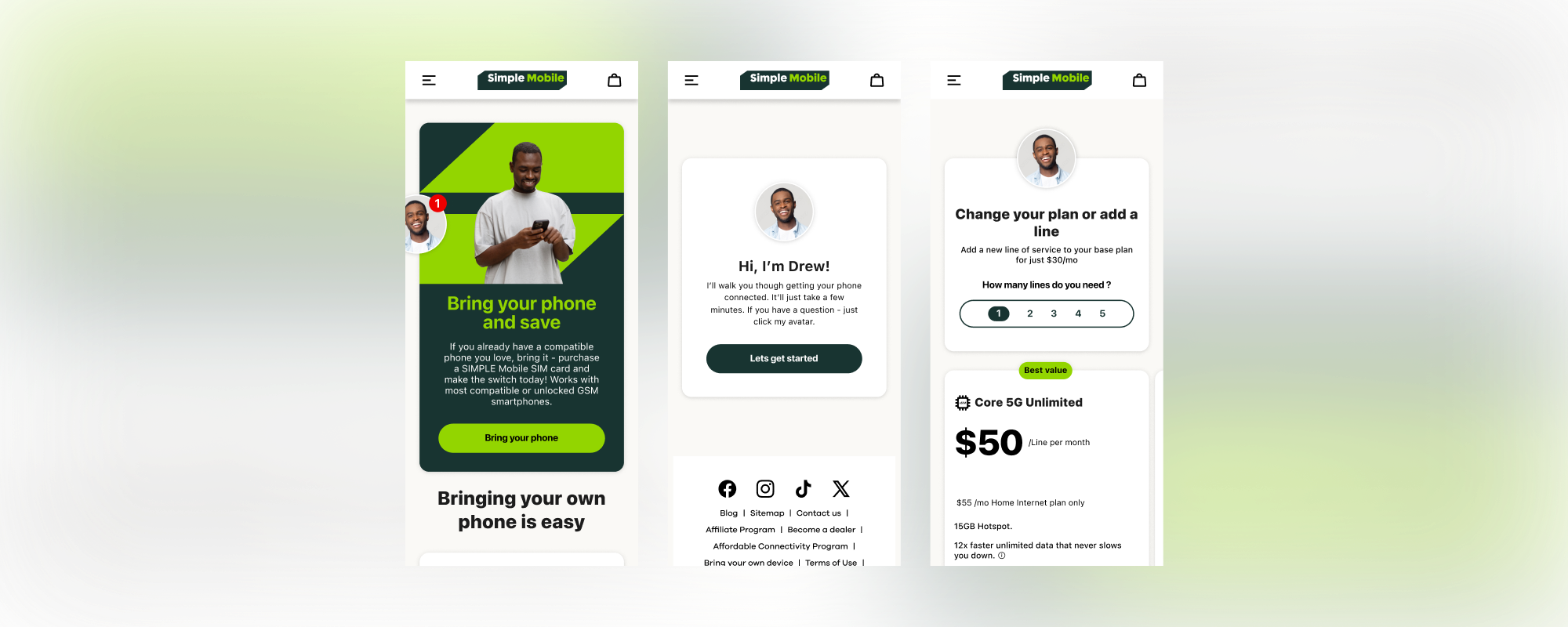
I led the redesign of the Bring Your Own Device (BYOD) activation experience, a critical onboarding and conversion flow within a telecom ecommerce journey. The existing experience required customers to manually locate and enter an IMEI, choose between eSIM and physical SIM, and complete provisioning across multiple disconnected steps — leading to high abandonment and support volume.
The goal was to reframe activation from a rigid sequence of tasks into a guided decision process grounded in clarity, reassurance, and reduced cognitive effort. In partnership with product and engineering, I redesigned the core flow and introduced contextual assistance to support customers through moments of uncertainty while preserving system accuracy.
Activation functioned as a conversion gate within the purchase journey. Customers struggled with device compatibility checks, IMEI entry, and SIM selection, often stalling or abandoning before completion.
Analysis of the journey showed the primary issue was not individual screens but decision uncertainty — users were asked to make technical choices without feedback or recovery paths, creating friction and support dependency.

The flow depended on telecom provisioning systems requiring precise inputs and sequencing, limiting how much the workflow could be simplified.
We also needed to support multiple user states, maintain compliance, and create interaction patterns scalable across value brands rather than a one-off solution.
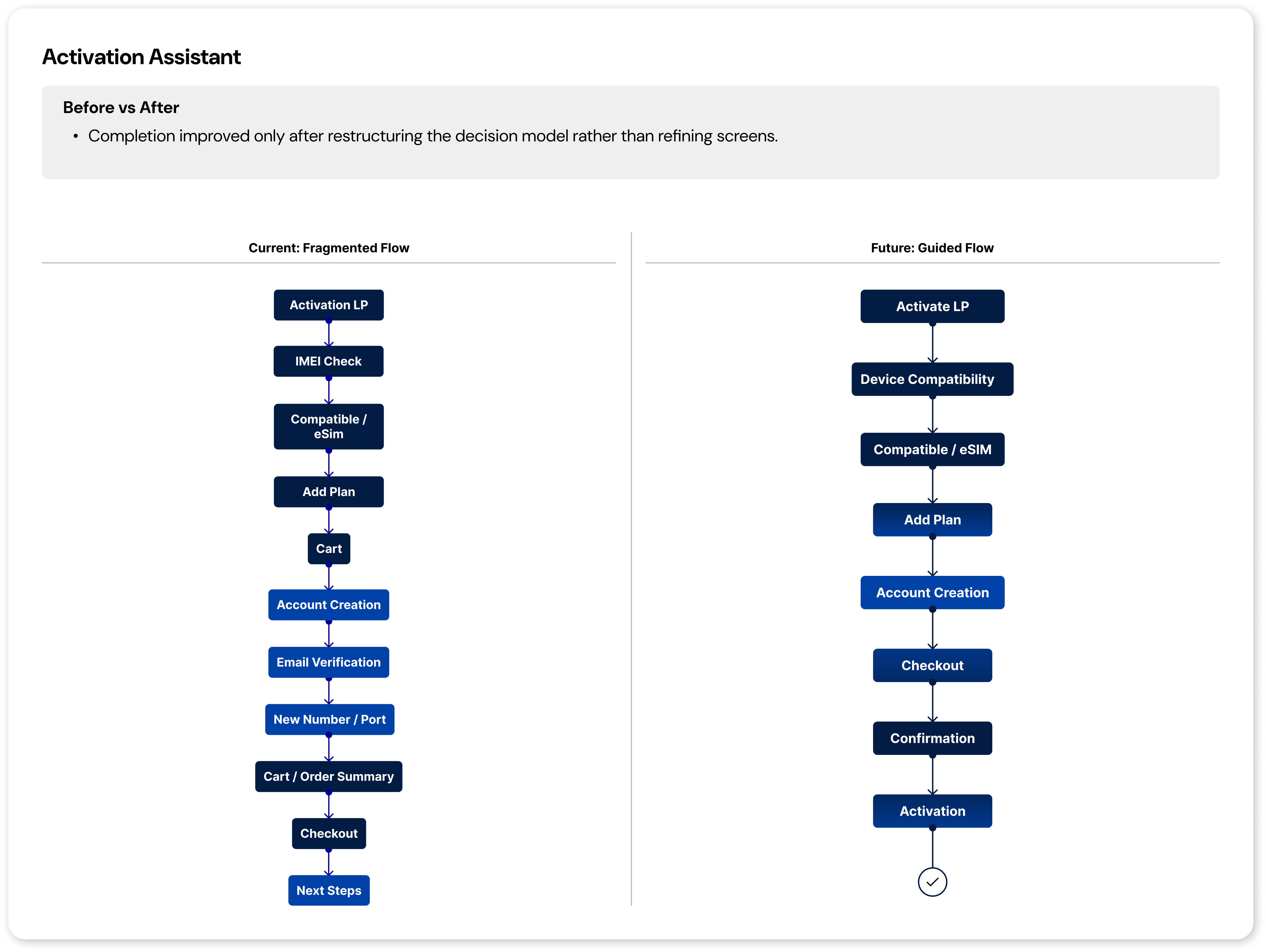
We mapped the end-to-end activation journey, including backend processes, to identify where users became blocked. This revealed a sequencing problem rather than a UI clarity problem.
We reorganized the flow around moments of intent, consolidating compatibility checks, unlock confirmation, and SIM selection into guided interactions that allowed recovery from errors while preserving technical requirements.
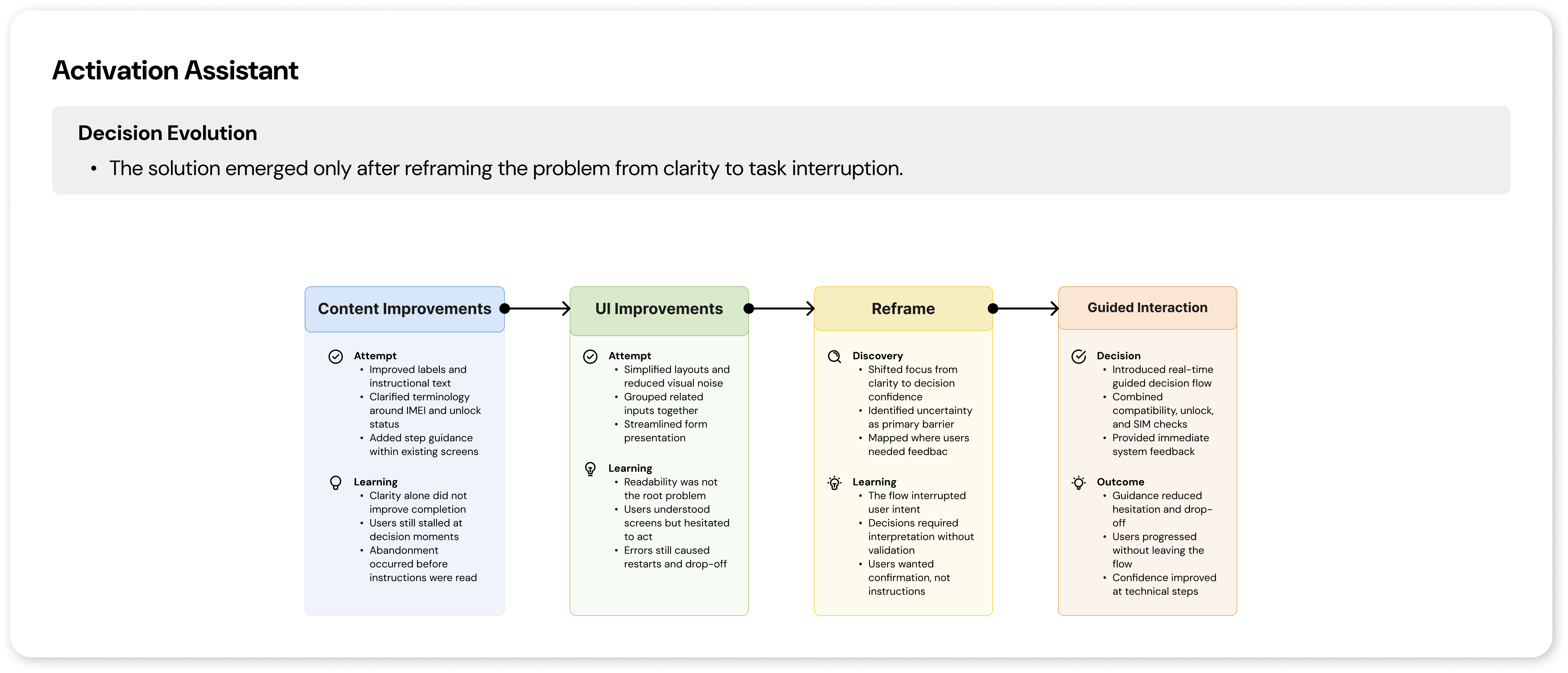
Early iterations improved copy and layout but did not significantly impact abandonment. Presenting this helped stakeholders align on restructuring the interaction rather than polishing screens.
We explored a guided interaction model where the system responded to user input in real time. Multiple technical validations occurred within a single step, reducing perceived complexity while maintaining accuracy.
This allowed key decisions — device selection, unlock status, and compatibility — to function as one continuous interaction instead of separate tasks.
The final experience combined simplified UI patterns with contextual guidance throughout activation. Instead of isolated tasks, the system responded dynamically to user input, clarifying requirements and supporting recovery without restarting the process.
The interaction model established a reusable framework for guided decision flows that could extend into onboarding, account management, and commerce experiences.
This project reinforced that improving conversion often requires restructuring decisions rather than simplifying visuals. By aligning stakeholders around user uncertainty and system constraints, the team moved from incremental optimization to a scalable interaction model designed to support both users and business outcomes.