
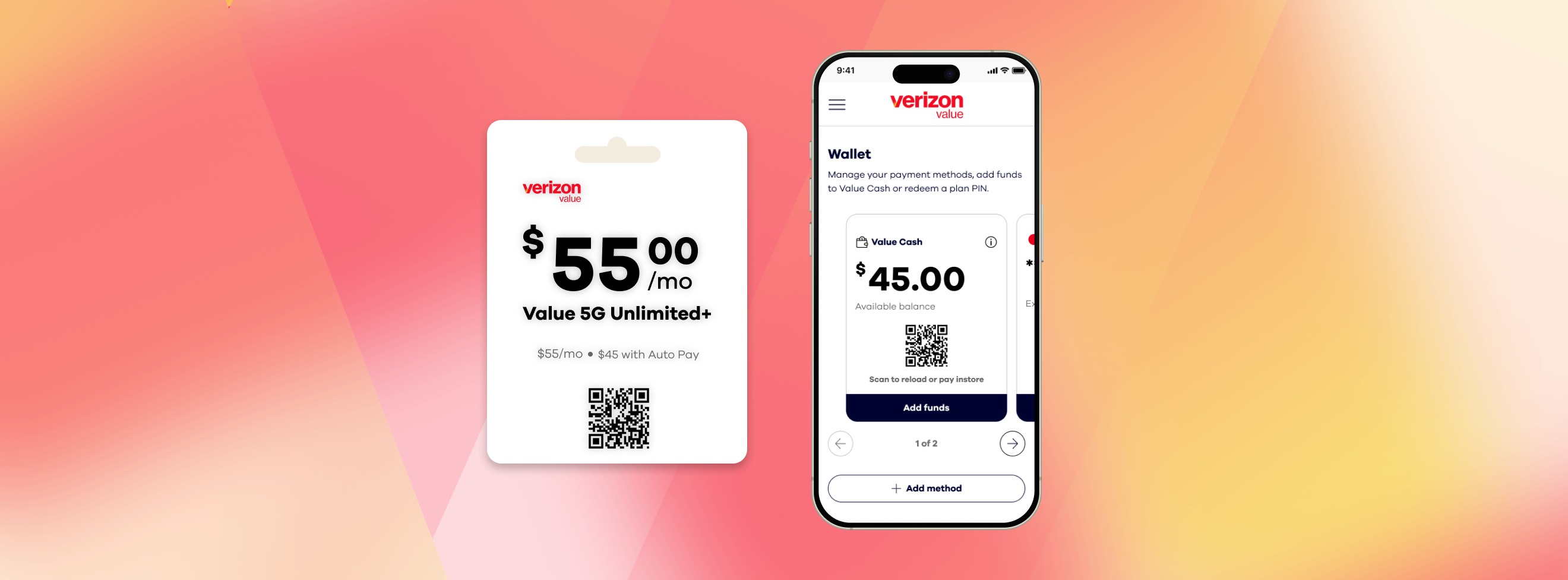
I led the redesign of the Authenticate + Pay experience for Verizon’s value brands, supporting prepaid customers as they accessed their accounts and refilled service. A large portion of payments occurred in-store using physical cash-based PIN cards, creating a disconnect between in-person and digital account management.
The goal was to enable reliable mobile payment and account access while bridging retail and online behaviors. The work spanned authentication, billing, and payment systems and focused on reducing service interruption, improving account creation, and moving customers toward repeatable digital payment patterns.
Customers frequently lost service because they could not successfully add funds in time. Login failures blocked payment, messaging was unclear, and payment methods varied across brands and platforms.
The refill process required multiple disconnected steps and did not reflect how customers managed money — especially for cash-based users and those on fixed income schedules — leading to abandonment and high-emotion support calls.

To understand why customers failed to refill service, I investigated the experience beyond individual screens and looked at behavioral signals across the system.
I reviewed refill funnel behavior to identify restart loops and abandonment, analyzed support call themes tied to service loss, and partnered with retail and care teams to understand how prepaid customers actually manage payments in the real world. I also compared in-store and digital journeys to understand why customers who could pay in person struggled online.
Rather than a usability issue, these signals revealed a mismatch between the system’s mental model and the user’s goal.
Customers were not trying to access an account
They were trying to restore service
Authentication was interpreted as a barrier
Not a safety step
Cash-reliant customers managed payments episodically
The system assumed continuous billing behavior
Most failures were confidence failures
Not payment failures
If authentication and payment are structured around the user’s immediate goal — maintaining service — rather than account ownership, completion reliability and trust will improve.
Authentication, billing, and payment systems operated independently and were governed by security and compliance requirements. Cash PIN payments were not interoperable with digital payment methods, and changes affected multiple downstream account workflows.
Solutions needed to work across logged-out, partially authenticated, and expired sessions while scaling to a large and diverse customer base.
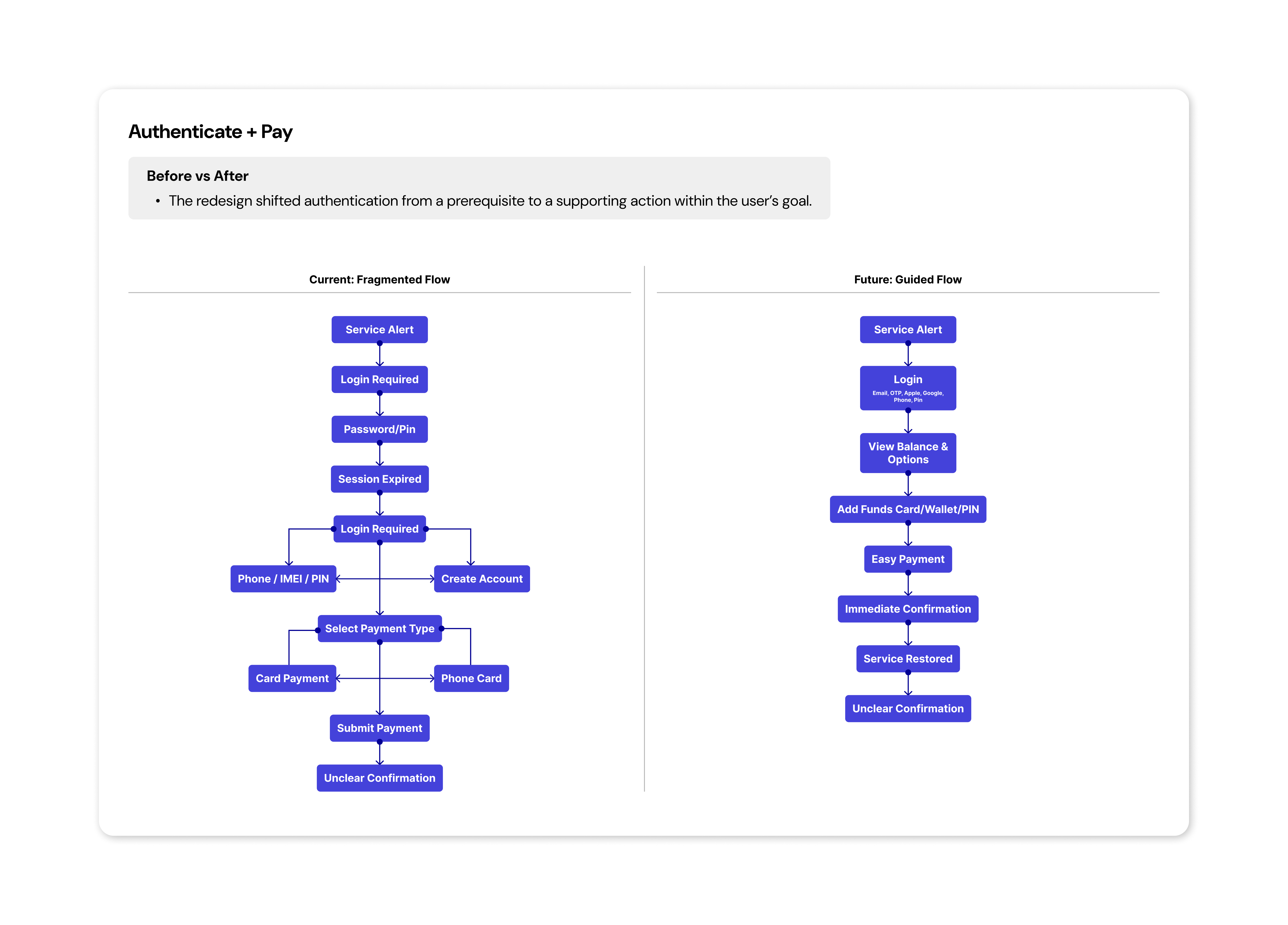
We mapped the end-to-end authentication and payment journey to identify where customers were blocked. The issue was continuity — users were forced to authenticate before completing an urgent task.
We reorganized the experience around intent, allowing payment to guide authentication rather than interrupt it. We introduced one-time passcode login, integrated familiar digital wallets, and expanded payment flexibility including split payments and scheduled payments.
Early improvements to messaging did not meaningfully change completion rates. This showed the issue was structural rather than informational.
We reframed authentication as progressive access: customers could move toward payment while the system verified identity in parallel. Cash value, digital payments, and account management were unified into a single mental model instead of separate flows.
Key decisions included:
The final experience connected authentication and payment into a continuous flow that supported both urgent and routine actions. Customers could add funds using cash, digital wallets, or stored methods without being blocked by login complexity.
The interaction model established a reusable account pattern that worked across entry states and brands, aligning in-store and online behaviors within one system.
This project demonstrated that reliability often depends on aligning system logic with user intent rather than simplifying screens. By reframing authentication as part of the task rather than a prerequisite, the team moved from patching flows to designing a cohesive account experience.